Code Intelligence
MDDB can tell an agent where a function is defined, which lines of which files
use it, what it calls, which tests touch it and — since 2.19.3 — which types
implement an interface. It answers on two levels of precision, through the same
code_symbol lookup.
| Heuristic (always on) | Semantic (autoindex --semantic, 2.19.3+) |
|
|---|---|---|
| Languages | 13: Go, Python, PHP, JS/TS, Rust, Java, C/C++, Ruby, CSS, Terraform, YAML, HTML, assembly | Go, Python, PHP, C, C++, Rust (2.19.4) |
| Where it comes from | mddbd reads each file alone with scanners | a language server reads the whole checkout, with its dependencies |
| Definitions | name and span | qualified name (Conn.Close), kind, span, enclosing type |
| References | name matches, plus full-text hits for x.f() calls |
the exact lines that refer to this definition |
| Same name, several definitions | one merged answer | ambiguous: true and a list of candidates |
| Callers, callees, tests | from the spans around each match | from the facts, per definition |
| Implementations | — | interfaces, abstract classes, protocols, C++ subclasses and overrides, Rust trait impls |
| Needs | nothing | a language server on the machine running mddb-cli |
precision in the answer |
omitted, or heuristic |
semantic, or mixed when only part of the collection has facts |
The heuristic level guesses where text cannot decide. In mddbd's own Go code,
54% of call sites go through a value or a package (s.Close(), pkg.Run()),
and 470 names are defined in more than one file (Close 19 times, Stats
30). The semantic level knows which Close each call means.
Quick start #
# 1. A language server for each language you index (see the table below).
go install golang.org/x/tools/gopls@latest

# 2. Index the checkout with facts. Run it where the code builds: the language
#    server needs the project's toolchain and dependencies.
mddb-cli autoindex . --semantic

# 3. Ask.
curl -s "$MDDB/v1/symbol?collection=myrepo&name=Close"
curl -s "$MDDB/v1/symbol?collection=myrepo&name=Store&include=implementations"
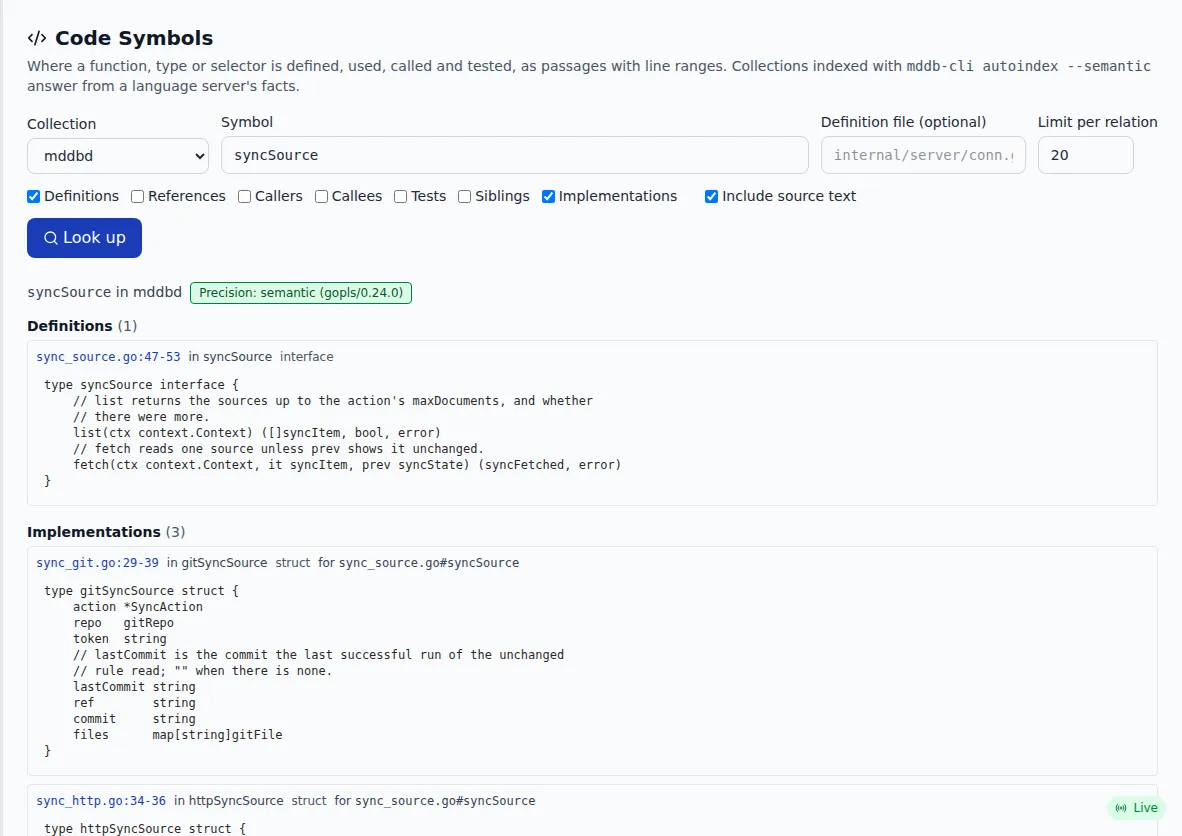
Agents use the MCP tool code_symbol with the same parameters, and the panel's
Code Symbols page shows the same answer. Run mddb-cli autoindex . --semantic
again after changes: it sends only the documents whose content or facts
changed.
Language servers #
mddb-cli uses the first server it finds on PATH, one language at a time.
mddb-cli diagnose lists the ones it found, with their versions.
| Language | Server (preferred first) | Install | Licence | Override |
|---|---|---|---|---|
| Go | gopls | go install golang.org/x/tools/gopls@latest |
BSD-3-Clause | MDDB_LSP_GO |
| Python | basedpyright, else pyrefly | uv tool install basedpyright (or pip install basedpyright; Node comes with it) / uv tool install pyrefly |
MIT | MDDB_LSP_PYTHON |
| PHP | phpactor, else PHPantom | the phpactor.phar from the phpactor releases (PHP 8.2+), or a PHPantom release binary |
MIT | MDDB_LSP_PHP |
| C, C++ | clangd (23 or later) | the static clangd-<os>-<version>.zip from the clangd releases, or the clangd package of the distribution or LLVM; needs the build's compile_commands.json |
Apache-2.0 WITH LLVM-exception | MDDB_LSP_C, MDDB_LSP_CPP |
| Rust | rust-analyzer | rustup component add rust-analyzer (cargo must be on PATH: it reads the workspace with cargo metadata) |
MIT OR Apache-2.0 | MDDB_LSP_RUST |
Versions tested on 2026-11-14: gopls 0.24.0, basedpyright 1.40.2, pyrefly
1.4.1, phpactor 2026.10.07.0, PHPantom 0.11.1, clangd 23.1.0, rust-analyzer
1.98.0. basedpyright comes before pyrefly
because pyrefly 1.4.1 returns no implementations of classes. An MDDB_LSP_*
variable replaces the built-in command (split on spaces, no shell), e.g.
MDDB_LSP_PHP="php /opt/phpactor.phar language-server". A versioned binary such as
MDDB_LSP_C=/usr/bin/clangd-22 is still recognised as the server in the table,
so it gets the table's arguments (for clangd, --compile-commands-dir).
Assembly stays on the heuristic level. The one maintained assembly language server (asm-lsp 0.10) resolves definitions and references only inside the file that is open, so it would add nothing to what the scanner already gives: every label, its span, and calls to it from other files.
C and C++ (clangd, 2.19.4) #
clangd 23.1.0 was tested on 2026-11-14. It runs as
clangd --background-index --log=info --compile-commands-dir=<dir>; the last
flag is added whenever the program is clangd, also when MDDB_LSP_C names it
elsewhere (keep --log=info in an override: the check below reads it).
- compile_commands.json is required. clangd learns each file's include
paths and defines from the build's compilation database.
autoindexlooks for it in the root, then<root>/build, or takes--compile-commands <file-or-dir>. Generate one with CMake (-DCMAKE_EXPORT_COMPILE_COMMANDS=ON),bear -- make, or Meson/Ninja (which write it). Without one,autowarns and the C and C++ files keep the heuristics;--semantic=cstops before anything is written. - Guessed flags are refused. If clangd still compiles an indexed file
without the database (it logs
Failed to find compilation database for …orwith command clangd fallback), the run returns no facts for C and C++: answers from guessed flags are partial and nothing in the protocol says so. - One server for both. A C++ project's
.hheaders count as C, so when both languages are indexed they run in one clangd (c+cppin the report) and references between headers and.cppfiles are kept. - Names.
geo::Square::areais stored asgeo.Square.area; namespaces prefix names but are not containers; anonymous namespaces add nothing; template arguments are dropped (List<T>::pushisList.push). A function is defined where its body is: header prototypes and in-class member declarations are not definitions (pure virtual methods are).typedefandusingaliases aretype. - Implementations are asked for C++ classes and methods only (subclasses and overrides); C has neither, so nothing is asked.
- clangd waits for its background index to finish before references are
asked, however long that takes within
--semantic-timeout; raise it for a large tree. The index is kept in.cache/clangd/next to the database, which makes the next run faster; add it to.gitignore. - Cross-compilers: add
--query-driver=<glob>throughMDDB_LSP_C.
Rust (rust-analyzer, 2.19.4) #
rust-analyzer 1.98.0 (the rustup component) was tested on 2026-11-14. It runs
as rust-analyzer with no arguments, and with checkOnSave off: the run
saves nothing, and the cargo check it would start compiles the crate for no
fact.
- The workspace must load. rust-analyzer reads the project with
cargo metadata, from aCargo.tomlat the indexed root or one directory below it. Index the crate or the workspace (autoindex services/my-crate), not a monorepo root with the crate deeper down. When it cannot load the workspace it says so (Failed to load workspaces.,Failed to discover workspace) while still answering every request from single files; the run then returns no Rust facts. - Readiness. The client asks for rust-analyzer's
experimental/serverStatusand asks references only once the server reports itself quiescent: the workspace loaded, build scripts run, proc-macros expanded and caches primed. On a large crate that takes minutes, within--semantic-timeout. Build scripts and proc-macros are built into the crate'starget/directory, as an editor would. - Names. Methods sit in impl blocks:
impl Square,impl Shape for Square,impl fmt::Display for Squareandimpl<T> Wrapper<T>all giveSquare.area,Wrapper.get— the self type without generics or path (impl crate::SquareisSquare,impl Shape for &'static strisstr). An inline module prefixes its items (mod inner { struct Hidden }isinner.Hidden); a module in its own file adds nothing, its path says where it is. A trait isinterface, its methodsmethod; a type alias istype; an associated function withoutself(new) stays afunction, in its type (Square.new). Look a name up asSquare::neworSquare.new. - Implementations are asked for traits and trait methods: a trait's are
the types that implement it (
LlmProvider→OpenAiProvider), a trait method's the methods of those impls. Implementations through#[async_trait]and other proc-macros are found. - Functions in a
mod tests(ormod test) are not asked for references: the harness calls#[test]functions by attribute, and their helpers are used only there.
Flags #
mddb-cli autoindex . --semantic                # auto: every language it can do
mddb-cli autoindex . --semantic=go,python      # these languages, or stop
mddb-cli autoindex . --semantic --dry-run      # run the servers, report, send nothing
mddb-cli autoindex . --semantic=c,cpp --compile-commands build/   # C and C++
- auto indexes each language that is in the tree, that the server accepts
facts for (
semanticinGET /v1/code-languages) and that has a language server installed. A missing or failing server is a warning; those files keep the heuristic level. - A list is a requirement: a missing server, a failing server or an mddbd older than 2.19.3 stops the run before anything is written.
--semantic-timeout(default20m),--semantic-concurrency(4),--semantic-memory-mb(gopls only),--compile-commands(clangd). Full reference: Bulk Import.
Reading an answer #
{
  "symbol": "Close",
  "ambiguous": true,
  "candidates": [
    {"path": "internal/net/conn.go", "name": "Conn.Close", "kind": "method"},
    {"path": "store/file.go", "name": "File.Close", "kind": "method"}
  ],
  "precision": "semantic",
  "semanticSource": "gopls/0.24.0"
}
ambiguous— several definitions match a bare name. Ask again with the candidate'sname(File.Close) andpath; the answer then lists only that method's references, callers and callees.targeton each reference says which definition it belongs to.precision:semanticmeans every definition and use came from facts;mixedmeans some files were indexed without them (for example a language without a server);heuristicmeans none. It is omitted from a heuristic answer to a request that did not ask forpathorimplementations, so older clients see exactly the answers they saw before.implementationsis empty without facts — that is the answer "not known", not "none".- Known limit: without
path, the candidates for a bare name come from the heuristicdefineslist, so interface methods and names in very large files (past its 512 names) are missing from them —Closein mddbd lists 21 of 23. Withpathevery definition in that file is found from the facts. - References through interfaces count: gopls reports a call through
io.Closeras a reference to everyClosethat satisfies it, and so does the answer.
Full field list: API,
MCP, GraphQL, gRPC. In
retrievalMode: graph, graphKinds accepts implementations
(Search).
How much better #
Measured on 50 random symbols per language (fixed seed), against what the language server itself reports; method and commands in Benchmark.
| Language | References correct (heuristic → semantic) | References found | Implementations right |
|---|---|---|---|
| Go (1349 files) | 38.5% → 100% | 88.8% → 93.5% (the rest is the 200-per-relation limit) | 40 → 50 of 50 |
| Go, methods with a shared name | 4.4% → 100% | 58.8% → 100% | |
| Python (14 files) | 57.8% → 100% | 70.5% → 100% | |
| PHP (39 files) | 84.2% → 100% | 91.7% → 100% |
The heuristic answer for Close in mddbd returned 681 lines for 51 true ones;
the semantic answer lists 21 candidates and, for WAL.Close, exactly the 55
lines gopls reports. Answers are about as large in tokens and no slower
(around 200 ms per lookup on the Go collection, either way). Search results
are unchanged.
Cost #
Measured on mddbd's own code (1343 Go files, 300 000 lines), gopls 0.24.0:
| First run | about 2.5 minutes; 18 272 definitions, 89 551 reference lines, 192 implementations |
| Second run, nothing changed | the language server runs again, 0 documents sent |
| Language server memory | 3.3–5.5 GB peak (gopls) |
| Rust: services/mddb-chat (118 files), rust-analyzer 1.98.0 | 1120 definitions, 5449 reference lines, 19 implementations; 12.7 s with a cold target/ (11 s of it loading), 5.5–6 s after; 2.2 GB peak |
| Facts in meta | median 1.2 KB, p99 9.2 KB per document; +55–65 MB on disk for the collection |
Without --semantic |
unchanged from 2.19.2 |
Languages run one after another, so the peak is the largest single server, not
the sum. Facts are recomputed for the whole tree on every --semantic run.
When facts go stale #
Facts describe the content they were computed from. Each document's symIndex
holds a hash of that content, and mddbd drops the facts the moment the content
changes through any API: the answer falls back to heuristic (or mixed)
until the next autoindex --semantic. Facts are never shown in search results;
reading a single document returns them.
Troubleshooting #
| Message or symptom | Cause | Fix |
|---|---|---|
language server did not load the workspace: N of M references requests failed |
the server could not build the project — most often a wrong toolchain (go.work requires go >= 1.27) or missing dependencies (vendor/, a virtualenv, composer install) |
fix PATH/GOTOOLCHAIN or install the dependencies, then run again; no facts are sent from a half-loaded project |
language server not found for python: none of [...] is on PATH; ... python files keep the heuristics |
none of the servers is on PATH |
install one, or set MDDB_LSP_PYTHON |
--semantic=php stops with semantic facts for php: ... |
a listed language is required | install the server, or use --semantic (auto) |
no compilation database (compile_commands.json) in <root> or <root>/build; ... |
clangd has no build flags for the tree | generate compile_commands.json, or name it with --compile-commands |
language server compiled files without the project's build settings: a.c, ... |
clangd fell back to guessed flags for those files (not in the database, or an override without --log=info hid the check — then this message never appears) |
regenerate the database from a build that compiles those files, or pass the right --compile-commands; no C/C++ facts are sent until then |
language server did not load the workspace: the server reports "Failed to load workspaces."; ... |
rust-analyzer found no Cargo.toml at the root or one directory below, or cargo metadata failed there (a broken manifest, an offline registry) |
run autoindex on the crate or workspace directory and check that cargo metadata succeeds there; no Rust facts are sent until then |
the server keeps no semantic facts (it predates 2.19.3) |
mddbd is older than the CLI | upgrade mddbd |
precision: mixed |
some files have no facts | index those languages with a server, or accept the mix |
symIndex ends in truncated |
the file had more than MDDB_CODE_MAX_FACTS (4096) facts |
references were cut first; raise the limit on mddbd if needed |
What MDDB does not do #
MDDB does not run language servers inside mddbd, and it offers no live language-server tools (hover, rename, diagnostics). Those belong in an editor or an agent working on the checkout, which has the files and the toolchain. MDDB keeps the facts it was given, so any client — a remote agent over MCP, the chat, CI, the panel — can ask about the code without a checkout.
autoindex --semantic is not offered over MCP: starting language servers from
a tool call is a separate security decision.
Adding a language #
The language-server table is one place in mddb-cli
(services/mddb-cli/internal/lspindex/servers.go). A new language is a new
entry — the command, the language id, how its symbol names nest (clangd's
hooks are in servers_clangd.go, rust-analyzer's in servers_rust.go) — plus a test
against the fake server, and semantic: true for it in mddbd's
/v1/code-languages. The fact format is in
testdata/semantic-facts/README.